Restaurant Grease Trap Compliance in Houston: The Quarterly Schedule Every Operator Needs
Picture this: it's a Tuesday morning, 9:47 a.m., and your kitchen crew is prepping for the lunch rush. A Houston Health and Environment inspector walks through your back door, clipboard in hand. The first thing she asks for is not your food handler certifications or your temperature logs. She asks for your grease trap manifest book. That three-ring binder — or digital equivalent — is her fastest read on whether you take FOG compliance seriously. If the last service date is more than 90 days ago, or if the manifest shows pumping at under 25% capacity, you are already in a conversation you do not want to be having during your prep window.
If you operate a commercial kitchen anywhere in Houston — downtown on Main Street, in a Heights breakfast spot, a Montrose late-night taqueria, an Energy Corridor cafeteria serving 400 lunches a day, or a food truck commissary in Stafford — this guide covers exactly what the city requires, what non-compliance actually costs, and how multi-location operators can build a service program that runs on autopilot.
Why Houston Cares So Much About FOG (And You Should Too)
Houston's sanitary sewer system handles billions of gallons of wastewater each year, and fats, oils, and grease are its single biggest enemy. When FOG cools inside sewer pipes, it congeals into thick blockages — the industry calls them fatbergs — that cause raw sewage overflows into streets, bayous, and neighborhoods. Harris County's bayous feed into Galveston Bay, a classified shellfish-harvesting area. A sewer overflow upstream triggers downstream closures that affect commercial fishing, tourism, and the city's federal standing with the EPA.
The EPA's Clean Water Act and Texas Commission on Environmental Quality (TCEQ) regulations both place responsibility on municipalities to control FOG at its source: the commercial kitchen. That is why Houston's Public Works and Engineering Department developed a formal FOG program, and why violations can result in fines from both the city and state agencies simultaneously. You are not just protecting your kitchen — you are part of a regional infrastructure equation that regulators take seriously.
Houston's FOG Ordinance — What's Actually Required
The controlling document is Chapter 47 of the Houston Code of Ordinances, which governs the city's FOG Control Program for food-service establishments (FSEs). Here is what it actually says, without the legalese.
Grease Trap or Grease Interceptor — There's a Difference
The ordinance distinguishes between two device types, and the distinction matters for your service schedule and cost.
A grease trap (also called an under-sink trap or a hydromechanical grease interceptor) is a smaller, indoor unit typically installed beneath a three-compartment sink or prep sink. Capacity ranges from 20 to 100 gallons. These are common in smaller FSEs, food trucks that use a commissary, and bars with limited kitchen operations.
A commercial kitchen grease interceptor is a large in-ground or exterior vault, typically 750 to 2,500 gallons or more, installed outside or below grade. Full-service restaurants, fast-casual chains, and high-volume commissaries almost always have at least one. Larger operations may have multiple interceptors.
The device type determines which maintenance schedule applies and what documentation is required. If you are not certain which type you have — or whether your device is properly sized for your current volume — that is worth confirming before an inspector does it for you.
Quarterly Pumping Requirement
Under Houston's FOG program, all food-service establishments are required to have their grease traps and interceptors pumped, cleaned, and inspected at minimum once every 90 days. This applies whether the device looks full or not. The quarterly schedule exists because grease accumulation is not always visible from the access port, and partial accumulation can still reduce the device's efficiency enough to allow FOG to pass into the sewer.
Scheduling matters here. A service that happens on day 91 technically places you out of compliance for one day. High-volume operations serving breakfast-through-dinner, locations with fryers running eight or more hours daily, and commissaries serving multiple trucks should treat 90 days as the outer limit, not the target date.
Manifest Documentation
Every service visit must produce a waste hauler manifest — a written record that includes the service date, the name of the licensed waste hauler, the amount of waste removed (in gallons), and the destination facility where the waste was disposed. Houston requires that FSEs retain manifests for a minimum of three years and make them available for inspection on request.
This is the manifest book the inspector asks for. A missing entry, an unlicensed hauler, or a destination that does not match a permitted disposal facility can each trigger a violation independently of whether your device was actually cleaned. Use only licensed grease waste haulers — your service provider should furnish a manifest automatically at each visit.
The 25% Rule — When You Must Service Before 90 Days
This is the rule that catches operators off guard. Houston's ordinance includes a provision often called the 25% rule: if grease and solids reach 25% of the total liquid depth of your interceptor at any point before the 90-day mark, you are required to service the device immediately — regardless of when the last pump occurred.
In practice, this means high-volume kitchens may need service every 30 to 60 days. A Tex-Mex restaurant with three fryers and a busy weekend brunch service accumulates FOG at a completely different rate than a sandwich counter with a single flat-top. Your service provider should be measuring accumulation at each visit and advising you when your volume warrants a shorter interval. If they are not doing that, you are flying blind on compliance.
The True Cost of Skipping a Pump
Let's be direct about the math. A single quarterly service for a mid-size restaurant typically runs $200 to $500. A large interceptor at a high-volume location might run $500 to $800. That feels like a significant line item until you look at what non-compliance actually costs.
- City fines: Houston's FOG program can assess fines starting at $500 per violation per day for failure to maintain required service schedules. Repeat violations escalate. Multiple violations discovered in a single inspection compound.
- Sewer damage liability: If a sewer backup is traced to FOG originating from your establishment, you can be held financially responsible for the cleanup — and those costs routinely run into the tens of thousands of dollars.
- Kitchen flooding: An overloaded grease interceptor does not just fail quietly. When it backs up, it backs up into your kitchen. A grease flood during service is a health code violation, an operational shutdown, and a staff and guest relations disaster simultaneously.
- Brand risk for chain operators: A health code violation or sewer incident at a single location generates local news coverage. For a regional chain — Shipley Do-Nuts franchisees, Whataburger-adjacent operators, HEB-adjacent food service — one location's citation becomes a searchable public record tied to your brand name.
- Permit jeopardy: Repeated FOG violations can put your food service permit at risk. No permit, no operation.
The quarterly service is not an expense. It is insurance with a predictable premium.
Single Trap vs. Multi-Location Compliance Programs
For an independent restaurant with a single kitchen, grease trap cleaning in Houston is a straightforward scheduled service. You call a licensed provider, get on a quarterly rotation, keep your manifests, and move on.
For a facilities manager overseeing 10, 20, or 50 locations across Greater Houston, the equation is fundamentally different. Each location has its own service interval, its own interceptor size and configuration, its own manifest documentation trail, and its own inspection exposure. Managing that manually — through a calendar and a stack of paper manifests — is how compliance gaps develop.
Multi-location operators need a compliance program, not just a service. The difference is centralized scheduling, unified documentation, and a single point of contact who understands the FOG compliance requirements for each location type in your portfolio. A commissary kitchen has different needs than a fast-casual counter. A food truck pickup point has different needs than a full-service dining room. Your provider should understand all of it and manage the service calendar accordingly.
One regional chain deal — even a modest 15-location group — represents 60 quarterly service events per year. That is meaningful revenue for a provider, which means you have negotiating leverage: consolidated billing, after-hours scheduling that does not interfere with operations, and digital manifest documentation that your compliance team can access without chasing paper.
What a Proper Quarterly Service Visit Includes
Not all service visits are equal. A thorough grease trap cleaning should include all of the following:
- Full pump-out: Complete removal of all grease, solids, and liquid waste — not just skimming the top layer. Partial pump-outs are a shortcut that leaves you with a device that fails sooner and a manifest that may not reflect actual condition.
- Scrape and clean of interior surfaces: Hardened grease adheres to baffles and interior walls. Surface cleaning after pump-out restores device efficiency and extends the interval before the next service becomes urgent.
- Water test and flow check: After cleaning, the device should be filled with water to verify proper flow and check for baffle integrity. A compromised baffle allows FOG to pass through unimpeded — meaning the device is present but functionally useless.
- Accumulation measurement and documentation: The technician should measure and record the pre-service accumulation depth. This is your 25% rule data point, and it tells you whether your service interval needs to be shortened.
- Manifest completion at time of service: The manifest should be completed, signed, and provided to you before the technician leaves. Not emailed later. Not mailed next week. At the time of service.
- Technician signoff with license number: The hauler's license number should appear on the manifest. This is a Houston requirement and your proof that the service was performed by a licensed operator.
If your current provider is not doing all of these steps, you are getting a partial service at a full-service price — and you are accumulating compliance exposure you may not be aware of.
What Multi-Location Chain Operators Should Demand From a Provider
If you are a facilities manager or regional ops director handling FOG compliance across multiple Houston-area locations, here is the checklist you should be running against any prospective provider:
- Centralized scheduling management: The provider should maintain the service calendar for all your locations, send advance scheduling confirmations, and proactively reschedule if a location's volume indicates an earlier service is needed. You should not be managing individual location schedules manually.
- Single-invoice consolidated billing: One invoice per billing cycle covering all locations, with per-location line items. This is standard for national service providers and should be non-negotiable for a multi-unit account.
- Real-time or on-demand manifest access: Digital manifests stored in a customer portal or emailed immediately upon service completion. Your compliance team needs to be able to pull a manifest for any location on 24 hours' notice — not wait for a paper copy to arrive.
- After-hours and off-peak service availability: Grease interceptor service during a Friday dinner rush is disruptive and sometimes impossible. A serious provider offers early morning, late evening, and weekend service windows without surcharge for standard accounts.
- Regional coverage across Greater Houston: Your locations span Harris, Fort Bend, Montgomery, and Brazoria counties. Your provider's service territory should cover all of them under the same account team — not require you to manage separate regional providers.
- Working knowledge of Houston Chapter 47 requirements: Your provider should be able to brief your location managers on compliance basics, not the other way around.
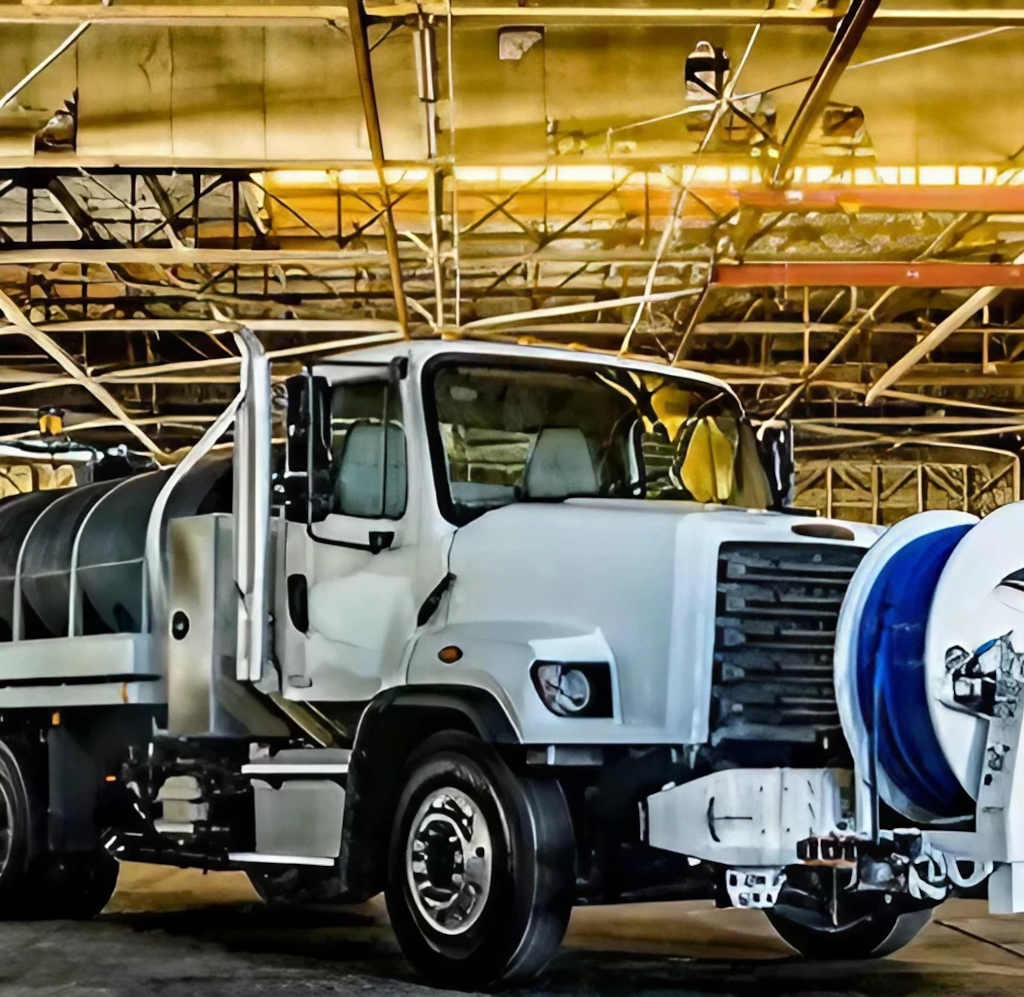
For operations that also deal with mainline buildup from FOG that has passed the interceptor, hydrojetting is the appropriate solution — high-pressure water cutting through grease deposits in the drain lines themselves. A full-service provider should offer both.
FAQ
Where does the grease go after it's pumped?
Licensed haulers transport grease waste to permitted receiving facilities — typically grease recycling operations that process it into biodiesel or animal feed supplements, or permitted industrial waste disposal facilities. Your manifest documents the destination, which is why the disposal site matters from a compliance standpoint. If a hauler cannot tell you where the waste goes, that is a red flag.
Can we clean the grease trap ourselves?
Under Houston's FOG program, self-cleaning is technically permitted for under-sink grease traps in limited circumstances, but it requires proper disposal of the waste — which means you still need a licensed hauler to transport it, and you still need a manifest. For in-ground interceptors, self-cleaning is not practical. More importantly, self-cleaning rarely produces documentation that satisfies an inspection. For most operators, the liability exposure from improper documentation exceeds the cost of hiring a licensed provider.
What about fryer oil — does that count as FOG?
Used cooking oil (UCO) from fryers is a separate waste stream from grease trap waste. Most operators have a separate used cooking oil collection program — typically a dedicated outdoor bin serviced by a UCO recycler, sometimes at no cost or with a rebate depending on volume. That is distinct from your interceptor maintenance. However, how your kitchen handles the disposal of fryer oil after draining — including whether residual oil gets washed down the drain — absolutely affects how quickly your interceptor loads up. Proper fryer oil management reduces your interceptor accumulation rate and can extend your service interval within compliant parameters.
What if our location is closed for a period — renovation, slow season, lease transition?
The 90-day clock runs on calendar days, not operating days. A location that is closed for six weeks still needs to be serviced if the 90-day mark passes. Some operators choose to document a closure period and negotiate with Houston Public Works on service timing, but that requires proactive communication with the regulatory authority — not silence. Contact the city's FOG program office before the service date lapses, not after.
We just got cited for FOG violations at one of our locations. What now?
Get the device serviced immediately and obtain a manifest before responding to the citation. Demonstrating that you have corrected the underlying condition before your response deadline is the most important step in mitigation. Then document a going-forward service schedule in writing, including the provider name, service frequency, and manifest retention protocol. Houston's FOG program responds more favorably to operators who self-correct promptly and demonstrate a structured compliance program than to those who argue the citation on technical grounds.
Get Your Quarterly Service Scheduled Today
TX Hydrojet and Plumbing serves commercial kitchens across Houston and Greater Harris County with restaurant grease trap pumping, interceptor cleaning, and full manifesting for FOG compliance under Houston's Chapter 47 ordinance. Whether you operate a single location or a regional portfolio of food-service establishments, we provide licensed service, real-time documentation, and the after-hours availability your operation requires.
Call (832) 203-7987 to schedule your next quarterly service visit, ask about multi-location program pricing, or discuss whether your current service interval is adequate for your kitchen's volume. We work with independent restaurants, commissary kitchens, food truck operators, and regional chain facility managers across the Houston metro.
Don't wait for an inspector to find the problem. Call (832) 203-7987 today.
TX Hydrojet & Plumbing Team
Our team of licensed, insured plumbers in Houston, TX brings decades of combined experience to every job. We specialize in hydro jetting, drain cleaning, sewer repair, and 24/7 emergency plumbing services across the Greater Houston area.
(832) 203-7987